


Click on the links below to read the articles:
 Property Owners that want to install multiple charging stations will want to consider the impact that the charging load will have on their utility bills for the building where the chargers are being added. Your installer or local utility can help estimate how the added load to the building will affect your monthly bill.
Many utilities offer, and in some areas may require, that new installations of EV charging stations be put on a specific rate plan. Some utilities offer pilot programs to help study EV charging load and may offer reduced rates in exchange for collecting detailed useage data.
If you have a facility that is going to install 10 or more EV charging stations or one that has limited capacity to provide power to new stations, it would be prudent to look into options that can reduce the impact on the building’s electrical system which in turn will help reduce the new infrastructure costs.
Some of the different methods are described below and are listed in increasing order of sophistication:
Some utilities offer, and in other areas may require that new installations of EV charging stations be put on a specific rate plan.
Not all charger manufacturers offer power sharing between chargers, as some feel that it affects the user experience in a negative way.
When chargers share the same circuit, the first customer that plugs into the shared charger will start the charger at the lower rate of:
A) The capability of the on-board vehicle system, or
B) The capability of the EV charging station.
When the second and subsequent users plug into chargers that share the same circuit, the charging rate is lowered to not exceed the selected setting. This limits the power available to both cars and could potentially prolong the charging of the vehicles connected. I say potentially, as not all cars have the capability to accept the same rate of charge. See the following example for an illustration of this principle:
 The ClipperCreek Share 2 HCS-40 station is capable of sharing a 40 amp circuit with a maximum charge rate of 32 amps.
Scenario 1: (Hardware built into the unit when made, not a software driven feature. Cannot be added on.)
Car A: 2013 Nissan Leaf, capable of charging at 32 amps.
Car B: 2013 Chevy Spark, capable of charging at 16 amps.
Car A plugs in and starts charging at 40 amps. Car B plugs in and the HCS-40 lowers the charge rate of Car A to 16 amps and starts charging Car B at 16 amps.
Scenario 2:If the cars swapped plug-in order… Car B plugs in first and starts charging at 16 amps, then Car A plugs in and starts charging at 16 amps. Car B still stays charging at its max rate.
In scenario 1, If Car A’s driver was hoping for a four-hour full charge to their car, they may come back to find out they only got about half of that.
Unless Drivers understand power sharing and the charging capabilities of how fast their car can charge up they might be confused when they go to different locations and don’t get the same amount of charge from seemingly the same type of charger.
Tesla Power Sharing
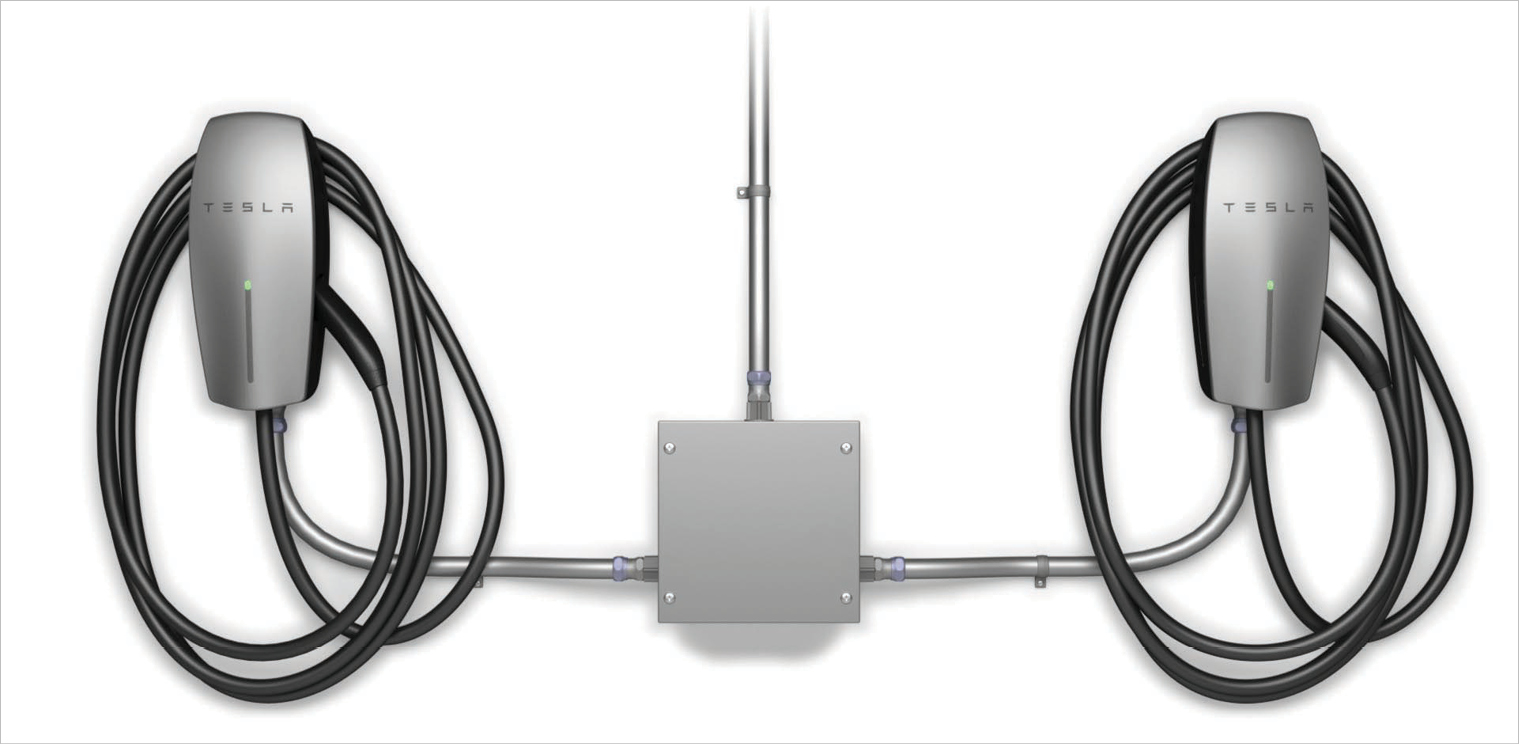 Tesla Power sharing is very similar to ClipperCreek’s, although they provide a larger range of options. Tesla can share up to four Tesla Wall chargers on one circuit and share from as little as a 15 amp circuit to a 100 amp circuit; although for better driver experience, Tesla recommends the following: four Chargers on a 100 amp circuit, three on an 80 amp circuit, and two on a 60 amp circuit. The Tesla Power Share will also detect a vehicle that has completed a charge and allow the others to share the available power left, as if the vehicle were not connected anymore.
Tesla promises a future software update will permit the new Gen 3 Wall connector to permit power sharing for up to 16 units.
ChargePoint Power Share (Software and hardware installation. Possible to add later.)
ChargePoint has a similar power sharing capability, although Chargepoint’s is more dynamic. As the charge rate on one vehicle lowers, it allows the other vehicle to charge at a higher rate. Again the upper limit of the charge rate is still the higher capability of the vehicle and the capability of the charging station. Chargepoint can be set to share one 40, 30, or 20 amp circuit between the two ports of a dual port charger.
ChargePoint Panel Sharing (Software related, must be done in the Chargepoint software.)
Another fairly unique feature of the Chargepoint system is the capability to do PanelShare.
To understand how the technology works, see the following example:
You, the property owner, have 8 individuals with EVs at your business/workplace/public dwelling, etc. They all come in at about the same time each morning and need to charge before they go home. But you don’t want them to have to get up in the middle of the workday to shuffle their cars around. You also have a limited power capability of the panel that will supply the chargers. For this example, let’s assume each vehicle can charge at 32 amps, which equals 256 amps (32 amps x 8 vehicles) of needed power. If your panel had only 200 amps available, you would have an issue. With PanelShare, the system would not allow draw to exceed the panel availability of 200 amps, and as one car finished a charge it would allow the others to charge faster, keeping the overall load to 200 amps or less.
This scenario would also be an argument for installing Level 1 stations, which would cut the charging rate in half, and allow you to install more stations, but everyone would get the same Level 1 charge rate (12-16 amps) until their charge was over. The PanelShare option could allow those that need to step out during the day to get more charge before they leave, or a higher charge rate when they come back (assuming that some of the other vehicles had completed a charge.)
Many buildings have an Energy Management System (EMS), Building Management System (BMS), or a Building Control System (BCS). These systems can monitor and in some cases control the operation of the lighting, Heating, Ventilation, and Air Conditioning (HVAC) security and other systems and subsystems in a building.
When adding EV charging (especially if you are adding DC Quick charging (DCQC) or 10 or more Level 2 stations) to a well-controlled building you should consider metering this new load as well as discussing available charging control systems during the charging station project.
 The added load for DCQC and EV charging can affect the energy bill savings that the Building Operations team operators have been working to control over the past number of years. Owners may reduce peak demand charges by having the building control the chargers to minimize or prevent the chance of reaching a new building peak load.
Clipper Creek (COSMOS)
The Clipper Creek HCS-40 and HCS-60 have an optional interface that allows many Building Control Systems to collect data, such as vehicle connected status, view charger status, and control charging power at four different levels using Digital and Serial communication methods.
Power Flex controls all the chargers to ensure drivers needs are met while balancing the needs of the building and utility.
Power Flex
The Powerflex system is a sophisticated system that provides a cost-effective installation if you need to add 20 or more EV chargers to your building or site.
The Power Flex’s Adaptive Charger Control System takes four EV driver inputs: vehicle type, charger type, departure time, and required mileage. This data is sent to the Load Management Controller (LMC) and can be coupled with building management limitations and utility demand response. Time of use and other parameters are all taken into account. Power Flex controls all the chargers to ensure drivers needs are met while balancing the needs of the building and utility. The PowerFlex System uses chargers from Clipper Creek or Webasto.
EverCharge EV Connector
Evercharge takes a different approach. It uses a non-centralized system of peer to peer chargers on a mesh network which the company calls Smart Power. There is no central controller. The devices communicate among themselves and adjust the power draw to stay below limits that have been configured by the installer.
Liberty Plugins Hydra-R Multi-Charger Control System
Liberty Plugins offers a controller system that can operate up to 10 EV Chargers with a single unit. It can provide access control capabilities and collect energy use data by individual users. This controller lets you select from a variety of non-networked chargers and turns them into smart chargers. Hydra-R can support Utility Demand Response programs and interface with building controls systems.